Training
Understanding Time Under Tension: A Guide to Reps and Tempo

Have you ever wondered what the 4-digit numbers on your training program mean? They are the key to unlocking your strength.
At Austin Simply Fit, nothing on your program is arbitrary. Every rep, every rest period, and yes, every one of those small numbers next to your exercises is programmed with intent. That 4-digit code is called a tempo prescription, and it’s one of the most powerful (and often overlooked) tools in strength training. Once you understand it, you’ll never look at a “rep” the same way again.
What Do Those 4 Digits Actually Mean?
Each digit in the tempo code represents the number of seconds spent in a specific phase of the movement. Take a squat as an example, with a tempo of 4-1-1-0:
- Digit 1 — Eccentric (4 seconds): The lowering phase, where the muscle lengthens under load. This is you descending into the squat.
- Digit 2 — Isometric/Bottom Pause (1 second): A pause at the point of peak stretch or maximum challenge, with no movement at all.
- Digit 3 — Concentric (1 second): The lifting phase, where the muscle shortens to produce force. This is you driving back up to standing.
- Digit 4 — Isometric/Top Pause (0 seconds): A pause at the top of the movement before the next rep begins.
Read left to right, that code tells your body exactly how to move through every single repetition — down, hold, up, hold. Four numbers, one complete story of the set.
How Tempo Dictates Time Under Tension (TUT)
Time Under Tension is simply the total number of seconds your muscle spends actively working during a set. It’s calculated by adding up all four digits of the tempo and multiplying by your rep count.
A 4-1-1-0 tempo means 6 seconds of tension per rep. Do 8 reps, and that’s 48 seconds of continuous muscular effort, not just a quick rush through 8 reps. This is the entire principle behind why two people can lift the exact same weight for the exact same number of reps and get completely different results. The person controlling their tempo is doing more actual work per rep, and their body knows it.
Are You Lifting the Weight, or Just Dropping It?
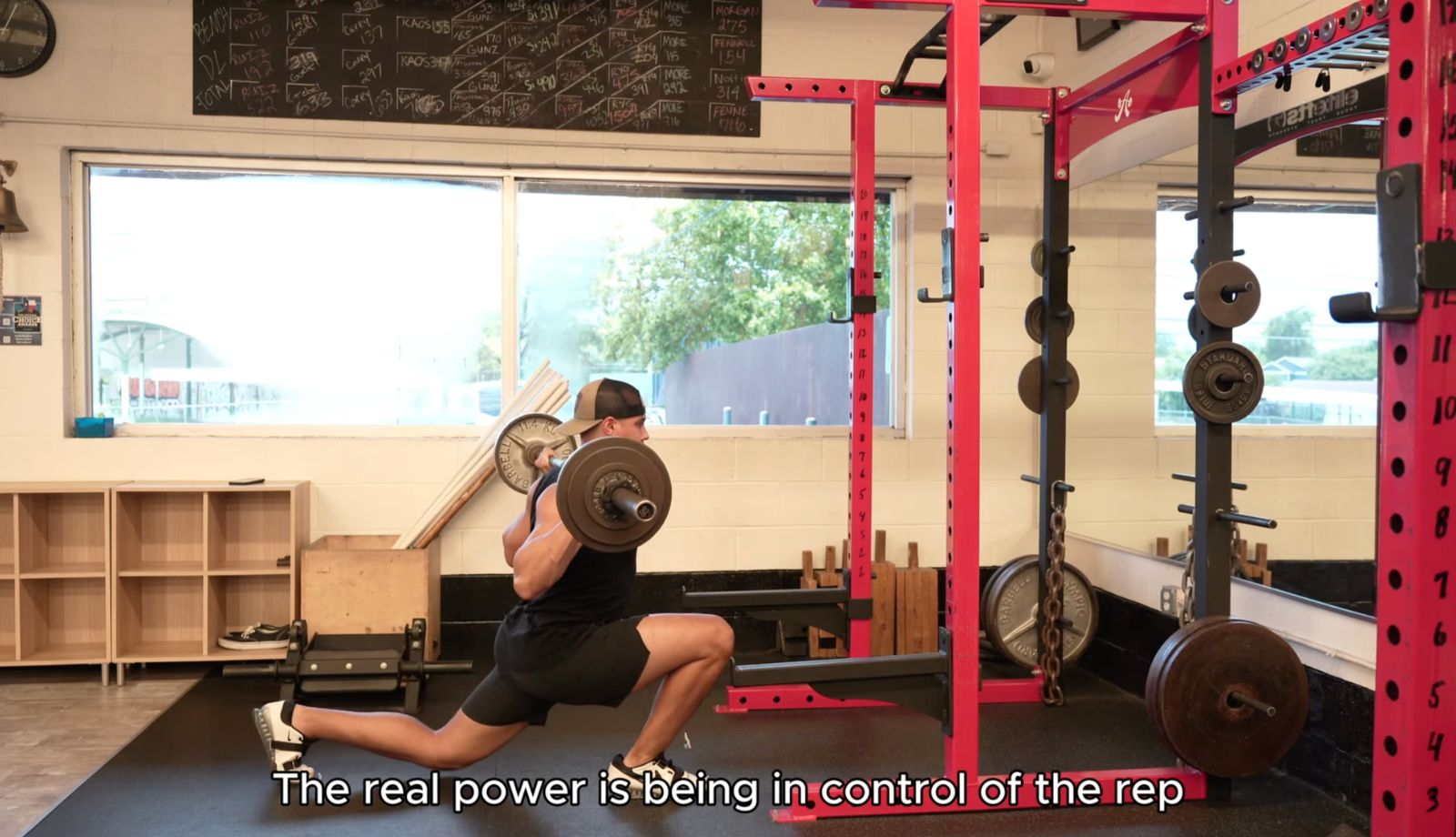 Here’s a question worth thinking about: are you actually controlling the weight through its full range of motion, or are you letting gravity do the lowering for you while you just reset for the next concentric rep?
Gravity is not your trainer. It doesn’t care about your goals, and it will happily do the eccentric phase for you if you let it. What it won’t do is build the muscle, control, or resilience you’re training for. Controlling the eccentric phase, the lowering portion of a lift, is one of the single most powerful triggers for both muscle growth and neurological learning. It’s where the deepest muscle damage (the good kind, the kind that drives adaptation) occurs, and it’s where your nervous system learns to stabilize and control load rather than just react to it.
Slow down to speed up your results. That controlled 4-count descent isn’t about making the workout harder for the sake of it, it’s about making sure every second of effort actually counts toward the outcome you’re training for.
The Neural-Metabolic Continuum: Matching Tempo to Your Goal
This is where precision coaching comes in. At Austin Simply Fit, we don’t just “add tempo.” We prescribe specific rep ranges and Time Under Tension windows based on the exact adaptation you’re training for. We call this the Neural-Metabolic Continuum.
| Rep Range | Adaptation | TUT Target |
| 1–5 reps | Relative Strength | 0–20 seconds |
| 6–8 reps | Functional Hypertrophy | 20–40 seconds |
| 9–12 reps | Hypertrophy | 40–70 seconds |
1–5 reps (Relative Strength): Short TUT windows here train your nervous system to recruit maximum motor units and produce force fast. This is about moving heavy loads efficiently, not accumulating fatigue.
6–8 reps (Functional Hypertrophy): The middle of the continuum, where you’re building both strength and size — enough tension to stimulate growth, while still developing the force output that carries over into real-world strength.
9–12 reps (Hypertrophy): Longer TUT windows maximize the muscular fatigue and metabolic stress that drive muscle growth. This is where controlled tempo work does its heaviest lifting.
Why This Matters at Austin Simply Fit
We built our programming around this continuum because we believe in efficiency. Every single second of effort in your session is optimized for your body, your goals, and where you are in your training. No wasted reps, no guesswork, nothing that doesn’t serve a purpose.
That 4-digit number isn’t a formality, it’s part of the precision coaching you get at ASF.
Next time you glance at your program, you’ll know exactly what those numbers are asking of you. That’s the difference between working out and training with purpose.
To get started on a program that is customized to your specific needs, click here to schedule your free consultation and structural balance assessment with one of our qualified personal trainers.